
There is a growing dispute over whether American government exists for the American people.
For most of American history, the first duty of government was not controversial. It was assumed.
The American founding stated it plainly: governments are instituted to secure the rights of the people who establish them.
The Constitution begins with the same premise. “We the People of the United States” — not an abstraction, not humanity in general, but a particular nation assuming responsibility for its own political life.
That principle formed the foundation of the republic.
The founders understood the danger of losing agreement on such first principles. In 1858, Abraham Lincoln warned that a nation divided over its fundamental commitments could not endure. His words were not merely rhetorical. They were a diagnosis:
A house divided against itself cannot stand.
And yet the recent State of the Union revealed something that should trouble anyone who takes the American experiment seriously.
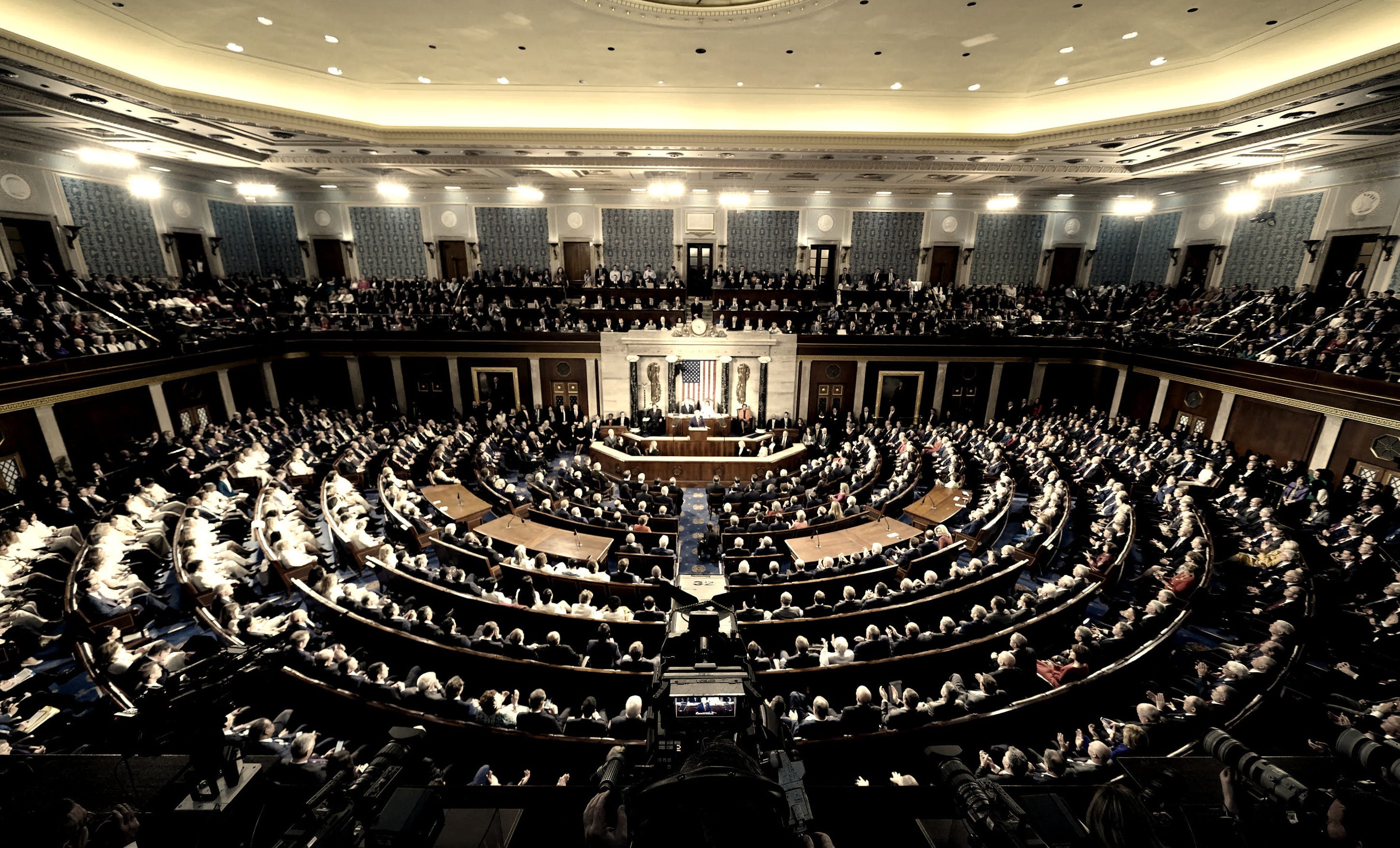
When the President asked members of Congress to stand if they believed the government’s first responsibility is to protect the citizens of the United States rather than those who entered the country illegally, nearly half the chamber remained seated.
Not since the great crisis of the nineteenth century has the nation witnessed such a brazen display of what can only be described as a spirit of sedition. What presents itself as ordinary partisan opposition increasingly reflects something more troubling: a governing philosophy that, if carried to its logical conclusion, would dissolve the principles that sustain the Union.
Members of Congress swear an oath to support the Constitution of the United States — a document that begins in the name of “We the People.”
The presidential oath states the duty even more plainly: “to preserve, protect, and defend the Constitution of the United States.” These are not ceremonial words. They express the fundamental obligation of American public office.
That obligation presumes agreement on a basic point: that the government of the United States exists to serve the American people, to uphold the constitutional order established by them, and to exercise its powers with fidelity to the citizens whose sovereignty gives the republic its legitimacy.
What was revealed in the chamber was therefore not merely a disagreement over immigration policy. It was a deeper fracture in the understanding of citizenship, borders, and national obligation.
One view continues to see government as responsible first to the people who established it. The other increasingly treats national preference itself as morally suspect.
That disagreement reaches beyond legislation. It touches the meaning of law, justice, citizenship, legitimacy, and ultimately the continuity of the Union itself.
Every functioning political community rests on a hierarchy of responsibility.
The family precedes the stranger.
The town precedes the distant city.
The citizen precedes the foreigner.
These priorities do not deny the moral worth of others; they make moral responsibility possible.
The instinct is not complicated. Families secure their homes at night not because they despise the outside world, but because they bear responsibility for those within.
Nations operate under the same logic. A government that attempts to owe everything to everyone cannot faithfully serve anyone at all.
The American republic was built upon this understanding. The Declaration of Independence explains that governments are instituted “to secure these rights,” deriving their just powers from “the consent of the governed.”
The legitimacy of American government therefore rests on a clear premise: political authority exists to protect the rights and security of the people who constitute the nation.
The Constitution reinforces the same idea in its opening words: “We the People of the United States.” That phrase identifies the political community that created the government and to whom that government is accountable. Every power granted in the Constitution flows from that act of collective self-government.
The framers did not treat this responsibility as theoretical. Article IV commits the United States to protect each state against invasion and to guarantee a republican form of government.
They understood that a government unwilling or unable to defend its own political community would soon lose the loyalty on which republican institutions depend.
This understanding was not uniquely American. The founders drew from a long tradition of political thought. The Roman statesman Cicero expressed it succinctly:
Salus populi suprema lex esto — the safety of the people shall be the highest law.
Centuries later John Locke argued that the chief end of political society is the preservation of the lives and property of its members.
By the time of the American founding, this principle required little explanation.
When the Founders spoke about the purpose of the republic, they did so with remarkable clarity. In 1790, in his First Annual Address to Congress, George Washington reminded the nation that
“The preservation of the sacred fire of liberty, and the destiny of the republican model of government, are… staked on the experiment entrusted to the hands of the American people.”
The point was unmistakable. Free government depends not only on institutions but on citizens who understand that the nation’s welfare is their own responsibility.
Without that shared civic understanding — without allegiance to the principles that sustain the Union — the structure itself cannot endure.
For generations that understanding held. Americans argued fiercely about tariffs, banking, expansion, civil rights, and the proper scope of federal authority. But the assumption that the American government existed primarily to serve the American people remained intact.
When disagreement arises over whether the government should prioritize the most essential duty it owes its citizens, the issue at stake is no longer simply policy. It is whether the government still recognizes its foundational obligation and can be trusted to operate under public confidence.
What the scene in the chamber suggests is that this assumption may no longer be universally shared.
If so, the nation must reckon with a troubling possibility: that the obligations of citizenship and the responsibilities of government are no longer understood in common.
Over several decades a different moral vocabulary has taken hold within parts of the country’s cultural and institutional leadership.
In the name of tolerance, openness, and humanitarian concern, national identity has been steadily weakened. Borders are treated primarily as barriers to compassion, and the distinction between citizen and non-citizen carries less moral weight.
Under the influence of this ideology, citizens are increasingly conditioned to accept ideas earlier generations would have recognized as self-destructive. It becomes possible for a statement about prioritizing the safety of one’s own people to sound unjust rather than obvious.
When citizenship is reduced to a procedural status — a formality disconnected from shared responsibility — the distinction between legality and illegality inevitably blurs. And when that distinction blurs, the foundations of law and self-government weaken with it.
American history offers warnings about moments like this. Long before the first shots were fired in 1861, events revealed a growing fracture in the nation’s underlying assumptions.
The debates over slavery’s expansion, the violence in Kansas, and the shockwaves of the Dred Scott decision pointed toward the same truth: Americans were no longer reasoning from the same premises.
Each side believed it was defending the true meaning of the republic.
That was the danger Lincoln recognized. Disagreement alone was not the threat. The threat was the loss of agreement about the principles that made the nation possible.
Tragically, the scene in the House chamber suggests the United States may once again be nearing such a moment.
The challenge facing the United States is therefore not simply partisan. It reflects a deeper philosophical divide. A political movement cannot plausibly claim to operate in good faith within the constitutional order while treating that order as something to be steadily undermined rather than faithfully upheld.
The country today is not divided into separate nations as it was in the nineteenth century. Our people live among one another, trade with one another, and share common institutions.
Yet the endurance of a republic depends on something deeper than proximity. It depends on agreement about the principles that hold the nation together.
A question that earlier generations would have answered without hesitation now divides the nation’s leadership.
The dispute, therefore, is deeper than legislation. It concerns the object of the republic itself — whether the American government exists first for the American people, or for a broader moral project that no longer recognizes that distinction.
A people may argue for generations about laws. They cannot remain united while arguing about the purpose of their government.
A nation can endure bitter policy disputes. It cannot endure uncertainty about the principles that give it life.
History suggests that moments like this are resolved not by avoiding the question but by answering it directly.
Lincoln did not preserve the Union by inventing a new theory of the nation. He returned to the principles already present in the Declaration of Independence and insisted that they still defined the American experiment.
By restating those principles clearly, he forced the country to confront what it believed.
Something similar may now be required again.
The scene in the House chamber lasted only a moment. Yet it illuminated a question that will shape the years ahead: whether Americans still agree about the first duty of their government and whether that government exists for its citizens or some alternative principle.
A republic ultimately depends on unity — not only on the process of elections and the administration of laws, but on a shared understanding of why the nation itself exists — who it will serve — and whether its citizens intend it to endure.
If you value serious discussion about the principles that sustain the American republic, consider subscribing.